Misellia and Friend Duo: The Perfect Friendly & Cute Script Font for Kids’ Crafts
When it comes to designing engaging, joyful, and age-appropriate materials for children, typography plays a surprisingly powerful role. Among the many fonts designed with young audiences in mind, Misellia and Friend Duo stands out—not just for its charm, but for its thoughtful, purpose-driven design. This friendly and cute script font duo is more than just “adorable”; it’s a versatile, educator-tested, and craft-ready typographic toolkit built specifically for kids’ creativity.
What Is Misellia and Friend Duo?
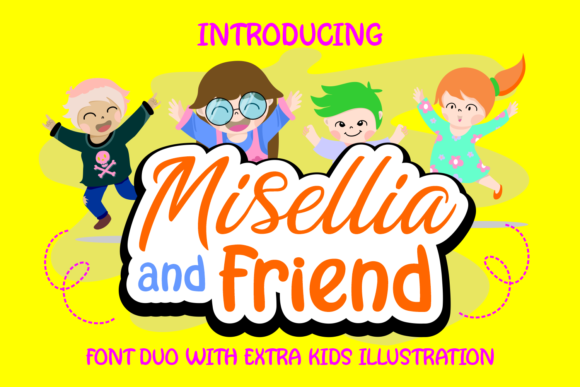
Misellia and Friend Duo is a coordinated pair of complementary fonts: Misellia, a warm, bouncy, hand-drawn script, and Friend, a clean, rounded sans-serif companion. Designed as a cohesive set, they’re not two unrelated fonts thrown together—they’re crafted to harmonize visually and functionally. Misellia brings personality and playfulness with its gentle loops, soft terminals, and subtle irregularities that mimic natural handwriting. Friend grounds the pairing with clarity and legibility—ideal for labels, instructions, or supporting text.
Unlike generic “kiddie” fonts that rely on exaggerated gimmicks (think dripping paint, cartoon wiggles, or forced cuteness), Misellia and Friend prioritize authentic friendliness. Their curves feel inviting, their spacing is generous, and their letterforms are carefully optimized for readability—even at small sizes on printed crafts or digital worksheets.
Why It’s Ideal for Kids’ Crafts (and More)
Kids’ crafts aren’t just about glue sticks and glitter—they’re foundational learning experiences. Through crafting, children develop fine motor skills, early literacy, color recognition, sequencing, and self-expression. Typography supports all of these:
- Visual scaffolding: Friendly letter shapes help emerging readers recognize letters faster—especially when paired with consistent, uncluttered forms like those in Friend.
- Emotional resonance: Warm, rounded fonts reduce cognitive load and signal safety and approachability—key for anxious or neurodivergent learners.
- Craft versatility: Whether cutting out alphabet cards, decorating storybook covers, or labeling nature-scavenger-hunt stations, Misellia and Friend scale beautifully across paper, vinyl, fabric, and digital screens.
Real-world examples include:
- A kindergarten teacher using Misellia for student name tags and Friend for classroom job charts—creating visual hierarchy without sacrificing warmth.
- A homeschool parent designing a “My First Journal” PDF where Misellia headlines each page (“Today I Saw…”) and Friend guides prompts (“Draw one thing!” or “Write your favorite color: ___”).
- An Etsy shop owner creating printable party kits—Misellia for “Happy Birthday!” banners and Friend for ingredient lists on cupcake toppers.
How It Fits Into Modern Creative & Educational Practices
In today’s hybrid learning landscape—blending physical classrooms, remote instruction, and home-based enrichment—teachers, parents, and designers need tools that work seamlessly across formats. Misellia and Friend Duo meets this need through smart technical design:
- OpenType features: Includes stylistic alternates, ligatures, and contextual swashes—so “hello” can look naturally handwritten, not robotic.
- Web-friendly formats: Available in WOFF2 and variable font options, enabling fast-loading, responsive craft blogs or interactive learning apps.
- Accessibility-aware spacing: Generous letter and word spacing improves scannability for early readers and supports screen readers when used with proper HTML semantics.
Beyond education, the duo supports inclusive business practices. Small creative businesses—like Montessori material makers or sensory-play subscription boxes—use Misellia and Friend to reinforce brand values: kindness, curiosity, and child-led discovery. It signals intentionality—not just “we made something for kids,” but “we made something with respect for how kids see, think, and grow.”
Common Misconceptions—Debunked
Some assume playful fonts lack professionalism—or worse, that “cute” means “unserious.” That’s a myth. Here’s what’s actually true:
- “Cute doesn’t equal childish”: Misellia’s refined stroke contrast and balanced rhythm give it maturity—it’s joyful, not juvenile. Designers use it in pediatric clinic signage, nonprofit campaigns for early childhood development, and even gentle wellness branding for families.
- “Script fonts are hard to read”: While some scripts sacrifice clarity for flair, Misellia was tested with children aged 4–8. Its high x-height, open counters (the enclosed spaces in letters like ‘a’, ‘e’, and ‘o’), and distinct lowercase ‘l’ vs. ‘i’ prevent common confusions.
- “You only need one fun font”: Pairing Misellia with Friend isn’t redundancy—it’s design strategy. Just as a teacher uses voice modulation (soft tone for stories, clear pace for directions), font pairing creates intuitive information architecture.
Practical Tips for Using Misellia and Friend Duo Effectively
Whether you're a first-time crafter or a seasoned curriculum designer, these best practices ensure your projects shine—and support learning:
- Use Misellia for emphasis, emotion, and identity: Titles, names, quotes, and decorative elements. Avoid long paragraphs—stick to short phrases (≤7 words) for optimal impact.
- Reserve Friend for structure and support: Captions, bullet points, step-by-step instructions, and accessibility labels. Its even weight and neutral tone keep focus on content—not decoration.
- Test print before cutting: Some craft printers compress fine script details. Print a test sheet at actual size—check loop closure in ‘g’, ‘y’, and ‘j’, and ensure Friend’s rounded corners remain crisp.
- Pair thoughtfully with color: Soft pastels, earthy tones, and high-contrast combos (navy + cream, charcoal + coral) let both fonts breathe. Avoid overly busy backgrounds that compete with Misellia’s delicate forms.
Why This Duo Matters Beyond Aesthetics
In an era where children spend increasing time with algorithm-driven interfaces and standardized digital assessments, tactile, human-centered creativity is more vital than ever. Fonts like Misellia and Friend Duo quietly advocate for slowness, care, and individuality. They remind us that learning isn’t just about outcomes—it’s about the feeling of tracing a curving ‘S’, recognizing your own name in joyful letterforms, or choosing colors that match the mood of a story you wrote yourself.
Educators report that students engage longer with materials featuring intentional typography. One preschool director noted, “When we switched our morning message board from a default system font to Misellia and Friend, kids started pointing out letters during circle time—‘That’s my ‘M’!’ ‘Look, the ‘o’ is smiling!’ It turned passive exposure into active discovery.”
That’s the quiet power of well-designed type: it doesn’t shout. It invites. It connects. And in the hands of caring adults—whether teachers, parents, therapists, or makers—it becomes a gentle bridge between imagination and expression.
Get Started Today—Thoughtfully and Joyfully
Misellia and Friend Duo isn’t just another download—it’s a creative partner for anyone who believes kids deserve beauty, clarity, and kindness in every detail of their learning world. Whether you’re prepping for back-to-school, launching a craft blog, or designing your child’s first reading journal, this font duo offers both heart and functionality.
Looking for inspiration? Try these beginner-friendly ideas:
- Create a personalized “All About Me” poster using Misellia for the title and Friend for fun facts (“My favorite animal: ___”, “I am kind because: ___”).
- Design reusable flashcards: Misellia for sight words, Friend for phonetic breakdowns (e.g., “cat → /k/ /a/ /t/”).
- Make a family recipe card—Misellia for the dish name (“Grandma’s Sunshine Cookies”), Friend for ingredients and steps.
Remember: great design for kids isn’t about oversimplifying—it’s about honoring their capacity for wonder while giving them the tools to explore it safely, clearly, and joyfully. With Misellia and Friend Duo, every letter becomes an invitation—to create, to learn, and to belong.