Yellow Dingbat Banners: Design-Ready Banner Elements for Faster, More Expressive Projects
Whether you're crafting social media graphics, printing event signage, building a brand mood board, or designing web banners for a small business launch, visual consistency and expressive flair matter—yet time is rarely on your side. That’s where Yellow Dingbat Banners steps in: not as another generic font pack, but as a purpose-built collection of cheerful, scalable banner elements rendered in a playful dingbats style—with yellow as its joyful anchor tone.
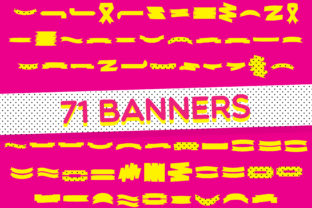
At its core, Yellow Dingbat Banners is a downloadable dingbats font file (typically in .OTF or .TTF format) that replaces standard keyboard characters with hand-crafted banner shapes—think ribbons, pennants, scalloped frames, speech-bubble banners, curved scrolls, and asymmetrical cutouts—all unified by warm, accessible yellow hues and clean vector outlines. Unlike clipart or raster PNGs, these banners are fully editable: change size without pixelation, adjust color in seconds, layer with text, and integrate seamlessly into Adobe Illustrator, Canva, Figma, or even PowerPoint.
Why Designers and Non-Designers Hit Roadblocks With Banner Graphics
Many professionals and DIY creators face overlapping challenges when adding banner accents to their work:
- Inconsistent styling: Mixing mismatched free PNGs leads to uneven line weights, clashing colors, and scaling artifacts—undermining polish.
- Time spent hunting and editing: Sourcing, resizing, recoloring, and aligning individual banner assets can consume 20+ minutes per graphic.
- Limited flexibility: Raster-based banners don’t scale for large-format prints or responsive web use—and often lack transparency or editable layers.
- Brand misalignment: Off-the-shelf graphics rarely match a brand’s voice—especially when warmth, friendliness, or approachability are key.
These aren’t just “nice-to-fix” issues—they directly impact how quickly a message lands, how credible a design feels, and whether a project ships on deadline. For educators making classroom posters, freelancers building client pitch decks, or marketers launching seasonal campaigns, speed *and* sincerity both count.
How Yellow Dingbat Banners Solves Real Workflow Gaps
Yellow Dingbat Banners doesn’t try to replace full design suites—it fills the precise gap between idea and execution. Its strength lies in immediacy and intentionality:
- One-click insertion: Type a letter (e.g., “A” for arched banner, “R” for ribbon), and a crisp, yellow-dominant banner appears—ready to type over, recolor, or rotate.
- Style cohesion built-in: Every banner shares proportional spacing, rounded terminals, and balanced negative space—so mixing shapes feels intentional, not accidental.
- Zero licensing friction: Licensed for commercial use, including client deliverables, merchandise, and digital ads—no attribution required.
- Accessibility-aware contrast: The yellow tones are carefully calibrated against common background colors (white, light gray, navy) to meet WCAG AA contrast thresholds when used at recommended sizes.
For example, a small bakery owner updating Instagram Stories every Tuesday can insert a scalloped “NEW” banner in under five seconds—then change its fill to match their logo’s accent color. No downloading, no cropping, no opacity tweaks. Just clarity and charm—on demand.
Practical Applications Across Roles and Tools
Different users engage with Yellow Dingbat Banners in ways that match their goals and tech comfort:
- Graphic designers use it as a rapid prototyping layer—placing banners behind headlines in mockups before committing to custom illustrations. They often pair it with sans-serif typefaces (like Inter or Montserrat) for clean, modern contrast.
- Teachers and trainers rely on it to highlight learning objectives or section dividers in handouts and slide decks—adding visual rhythm without overwhelming students.
- Social media managers build reusable Canva templates using the banners as fixed-position elements—ensuring every “Sale,” “Tip,” or “Reminder” post carries consistent energy.
- Nonprofits and community groups apply it to volunteer flyers and event posters, where friendly visuals help convey warmth and inclusivity—without requiring design expertise.
Pro tip: In vector editors, convert the banner glyph to outlines (Type > Create Outlines in Illustrator), then use the Pathfinder tool to merge or subtract shapes—turning a simple banner into a custom badge or label in under a minute.
Getting the Most From Your Yellow Dingbat Banners Experience
To maximize usefulness—not just novelty—keep these considerations in mind:
- Start simple: Don’t try to use all 50+ banner variants at once. Pick three shapes that suit your most frequent needs (e.g., a top-aligned ribbon for headers, a centered scroll for quotes, a corner pennant for callouts).
- Respect hierarchy: Use larger banners for primary messages (“Grand Opening!”) and smaller, subtler ones for secondary cues (“Limited Time”). Avoid stacking multiple banners in one composition unless intentionally creating a festive, layered effect.
- Test color pairings: While yellow is the default, the font supports full RGB/HEX recoloring. Try muted golds for luxury brands, ochres for earthy aesthetics, or high-contrast black-and-yellow for urgency (e.g., safety notices).
- Pair with legible type: Dingbats fonts shine when supporting—not competing with—text. Always ensure headline copy has sufficient size, weight, and spacing inside the banner shape.
And remember: Yellow Dingbat Banners works best when treated as a utility—not a crutch. It accelerates execution, but your judgment about tone, timing, and audience remains essential. Let it handle the “how,” so you can focus on the “why.”
A Resource That Grows With Your Needs
What makes Yellow Dingbat Banners especially valuable over time is its adaptability. As your projects evolve—from static PDFs to interactive web components—you’ll find new uses: embedding banner glyphs as SVG icons via CSS @font-face, exporting them as scalable assets for developer handoff, or even animating them with simple CSS transforms for micro-interactions.
It’s not about collecting more tools. It’s about choosing tools that reduce friction, honor your audience’s attention, and reflect your values—whether that’s clarity, joy, professionalism, or all three. When a banner element does more than decorate—and instead helps communicate faster, connect more warmly, and ship more confidently—that’s when design truly serves its purpose.
If you’ve ever paused mid-project wondering, “How do I make this feel finished, without spending another hour on details?”—Yellow Dingbat Banners is the quiet, capable answer waiting in your font menu.